SEGA Survivors www.sc-3000.com ©2008
Page 1
An Interview with Robert B. Brown
aka. Brian Brown
Author of the Sega Programming Manual
And numerous Grandstand program’s.
Date of Interview: 29th May to 5th June 2008
Interviewer: Aaron Wheeler
AW> Thanks for taking the time to answer our questions Brian, or do you prefer to be called Robert?
RBB> It’s part of the Gulf mentality - everyone is called by their first name, where as for the first 40+ years of
my life, in New Zealand, I was called by my middle name. It took a bit of getting used to at first on arrival here. I
guess people thought I was deaf for the first few months as I wasn’t responding to Robert... However, after 8
years I seem to have adapted.
AW> Maybe you can start out by telling us a little about yourself and where you currently reside?
RBB> I currently reside in the UAE, been here since 2000, Previously Dept Chair IT Programs at Abu Dhabi
Women’s College. I am now working on Accreditation issues, for the Higher Colleges of Technology in Abu
Dhabi.
Since
arriving
in
the
UAE,
I
masterminded
the
UAE
Educational
IT
Challenge
http://www.uaechallenge.com and the HCT Robotics Challenge http://www.uaerobotchallenge.com.
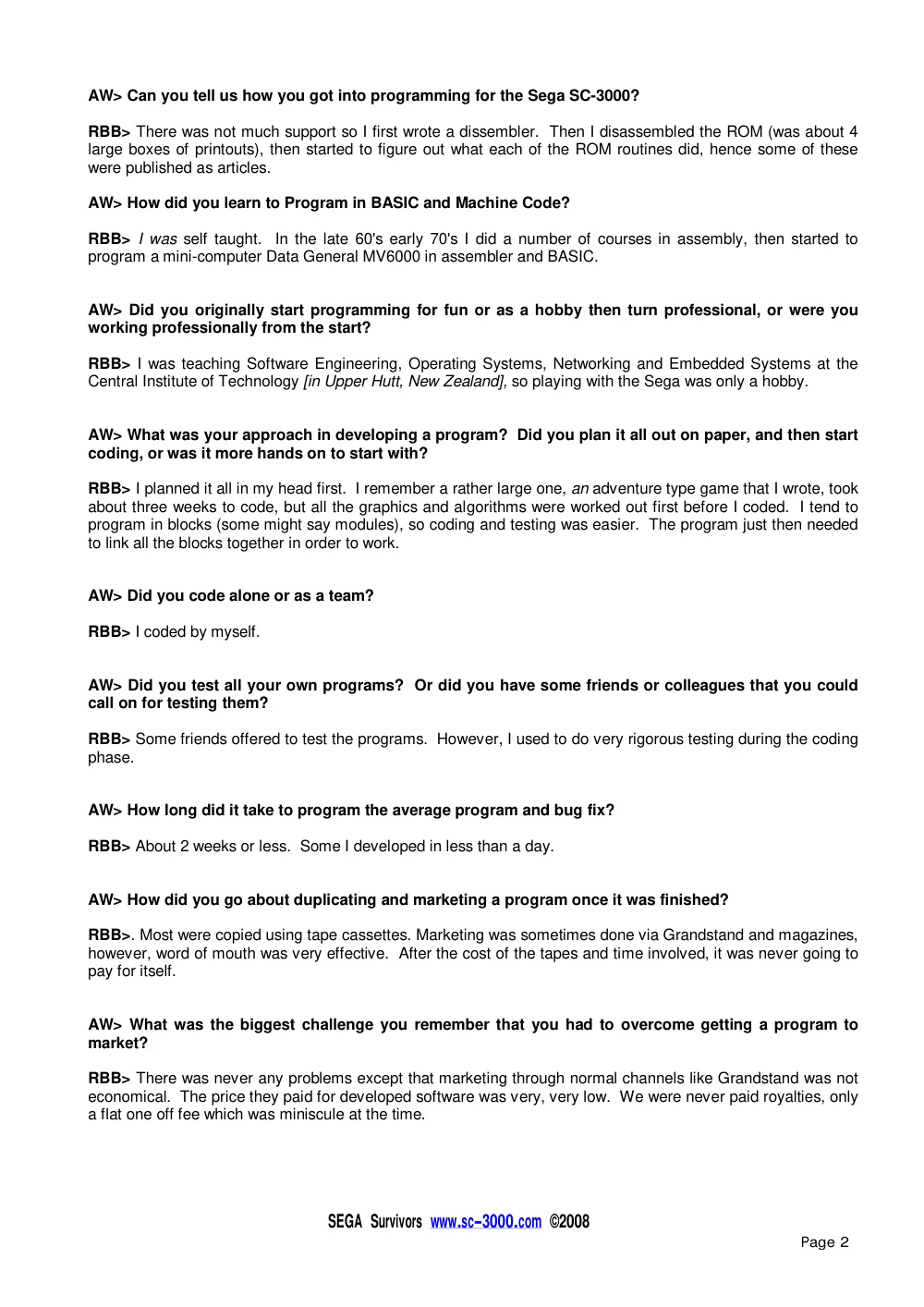
AW> The Robotics Challenge looks great. Using the Lego 9797
Mindstorm set, there seems to be some challenging missions set.
You say you masterminded that event, how did that come about?
How well do the teams normally do in the challenges?
RBB> It came about because the students in Higher Diploma struggle
with programming concepts, this is their first programming course, and
they normally start with Visual Basic. We needed something simpler
that would teach them programming, be easy to use, and also help
them migration concepts to VB later. Being interactive, when they
make a mistake the robot goes astray, it’s good. And the teams did
very well.
AW> Was the Sega SC-3000 your first computer? Or had you owned others prior?
RBB> No, I had owned a Disk Smith computer based on the TRS80. I rewrote the file system in assembler to
support hieracherical folders and files (TRSDOS). I also briefly owned an Atari 800XL and ZX81.
AW> What Sega Hardware did you own and use? Do you still own any Sega Hardware?
RBB> I had a SC3000 with expansion unit [SF-7000]. No I don’t.
AW> Why did you purchase a Sega SC-3000?
RBB> Price and it’s sound/graphics capability.
AW> What aspect of the Sega SC-3000 hardware would you have liked to have seen improved at the
time?
RBB> More memory and better expansion capabilities. Use of standard floppy disks.
1 / 5
SEGA Survivors www.sc-3000.com ©2008
Page 2
AW> Can you tell us how you got into programming for the Sega SC-3000?
RBB> There was not much support so I first wrote a dissembler. Then I disassembled the ROM (was about 4
large boxes of printouts), then started to figure out what each of the ROM routines did, hence some of these
were published as articles.
AW> How did you learn to Program in BASIC and Machine Code?
RBB> I was self taught. In the late 60's early 70's I did a number of courses in assembly, then started to
program a mini-computer Data General MV6000 in assembler and BASIC.
AW> Did you originally start programming for fun or as a hobby then turn professional, or were you
working professionally from the start?
RBB> I was teaching Software Engineering, Operating Systems, Networking and Embedded Systems at the
Central Institute of Technology [in Upper Hutt, New Zealand], so playing with the Sega was only a hobby.
AW> What was your approach in developing a program? Did you plan it all out on paper, and then start
coding, or was it more hands on to start with?
RBB> I planned it all in my head first. I remember a rather large one, an adventure type game that I wrote, took
about three weeks to code, but all the graphics and algorithms were worked out first before I coded. I tend to
program in blocks (some might say modules), so coding and testing was easier. The program just then needed
to link all the blocks together in order to work.
AW> Did you code alone or as a team?
RBB> I coded by myself.
AW> Did you test all your own programs? Or did you have some friends or colleagues that you could
call on for testing them?
RBB> Some friends offered to test the programs. However, I used to do very rigorous testing during the coding
phase.
AW> How long did it take to program the average program and bug fix?
RBB> About 2 weeks or less. Some I developed in less than a day.
AW> How did you go about duplicating and marketing a program once it was finished?
RBB>. Most were copied using tape cassettes. Marketing was sometimes done via Grandstand and magazines,
however, word of mouth was very effective. After the cost of the tapes and time involved, it was never going to
pay for itself.
AW> What was the biggest challenge you remember that you had to overcome getting a program to
market?
RBB> There was never any problems except that marketing through normal channels like Grandstand was not
economical. The price they paid for developed software was very, very low. We were never paid royalties, only
a flat one off fee which was miniscule at the time.
2 / 5
SEGA Survivors www.sc-3000.com ©2008
Page 3
AW> What was the software market like for the Sega SC-3000?
RBB> When it, the SC-3000, first came out it was very poor. The support for developers was non-existent.
They would not release details of the ROM or any special routines. This stifled the ability of people to write in
anything but BASIC.
AW> Of your own software, which do you like the most? Which would you have liked to improve?
RBB> The Adventure program. Limitations of memory required me to reduce the graphics which was a shame.
Of the others, I remember little.
AW> Were your programs well received at the time? How well did they sell?
RBB> They were very popular. A lot were given away for next to nothing. It would be an overstatement that I
actually made any money.
AW> Did you write any programs that didn't make it to market?
RBB> I had worked on a C Compiler. There just wasn’t the market in NZ to release it.
AW> Do you think the companies that supported the Sega SC-3000 did a good job with their support, or
did they leave the Sega to it's own devices?
RBB> They only wanted to sell games, they were not interested in trying to develop a community of users as
such.
AW> If you could go back to the 80's and start again, would you have stayed with the Sega platform for
as long as you did, or would you have bypassed the Sega and coded for another platform?
RBB> I had fun with the Sega, it taught me a lot. I don’t regret using it at the time.
AW> Did you contribute to any of the Sega Magazines of the day?
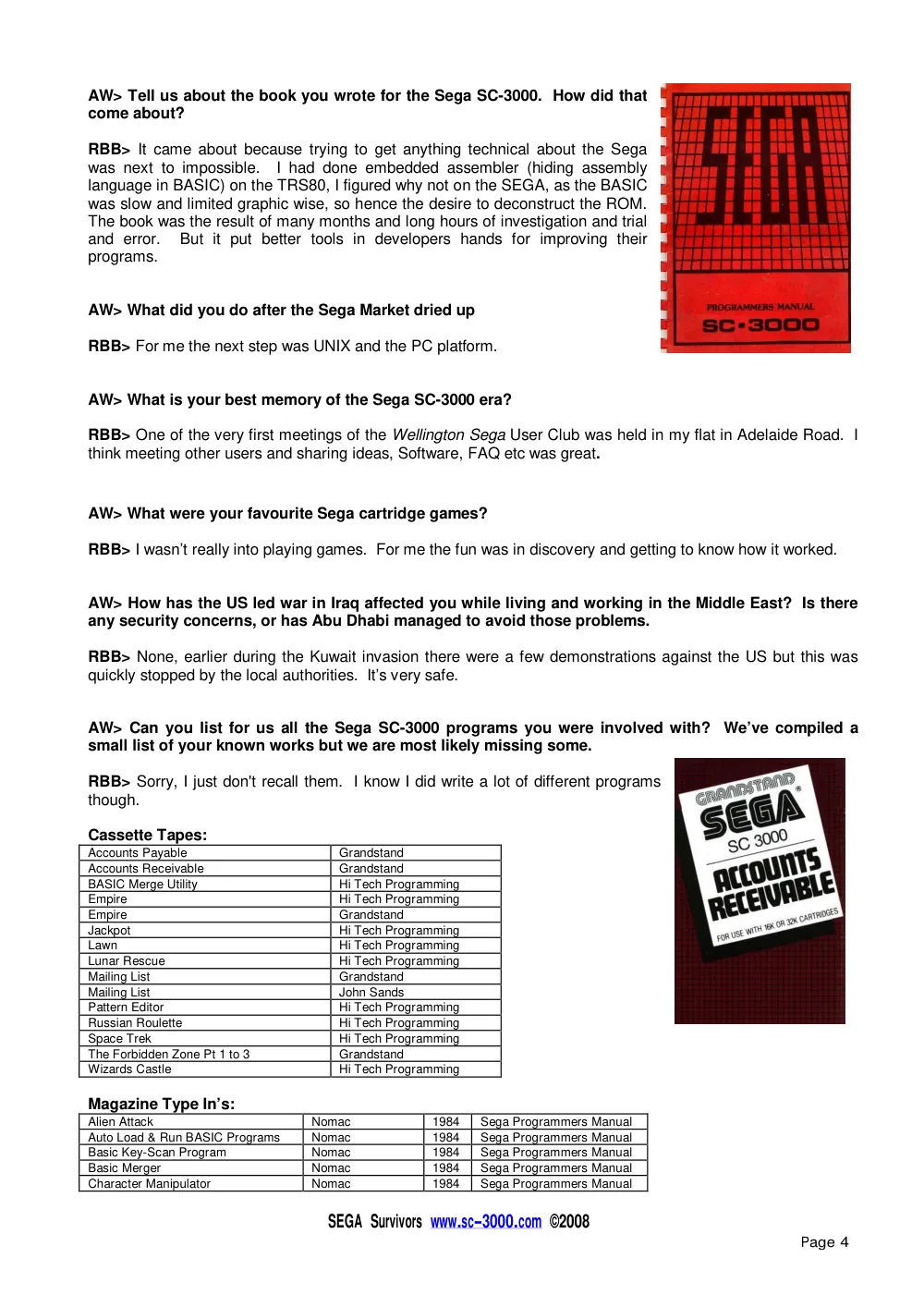
RBB> Yes, for both the Sega Computer and Computer Input magazines. For how long I cannot remember.
The majority of this was unpaid at the time.
3 / 5
SEGA Survivors www.sc-3000.com ©2008
Page 4
AW> Tell us about the book you wrote for the Sega SC-3000. How did that
come about?
RBB> It came about because trying to get anything technical about the Sega
was next to impossible. I had done embedded assembler (hiding assembly
language in BASIC) on the TRS80, I figured why not on the SEGA, as the BASIC
was slow and limited graphic wise, so hence the desire to deconstruct the ROM.
The book was the result of many months and long hours of investigation and trial
and error. But it put better tools in developers hands for improving their
programs.
AW> What did you do after the Sega Market dried up
RBB> For me the next step was UNIX and the PC platform.
AW> What is your best memory of the Sega SC-3000 era?
RBB> One of the very first meetings of the Wellington Sega User Club was held in my flat in Adelaide Road. I
think meeting other users and sharing ideas, Software, FAQ etc was great.
AW> What were your favourite Sega cartridge games?
RBB> I wasn’t really into playing games. For me the fun was in discovery and getting to know how it worked.
AW> How has the US led war in Iraq affected you while living and working in the Middle East? Is there
any security concerns, or has Abu Dhabi managed to avoid those problems.
RBB> None, earlier during the Kuwait invasion there were a few demonstrations against the US but this was
quickly stopped by the local authorities. It’s very safe.
AW> Can you list for us all the Sega SC-3000 programs you were involved with? We’ve compiled a
small list of your known works but we are most likely missing some.
RBB> Sorry, I just don't recall them. I know I did write a lot of different programs
though.
Cassette Tapes:
Accounts Payable
Grandstand
Accounts Receivable
Grandstand
BASIC Merge Utility
Hi Tech Programming
Empire
Hi Tech Programming
Empire
Grandstand
Jackpot
Hi Tech Programming
Lawn
Hi Tech Programming
Lunar Rescue
Hi Tech Programming
Mailing List
Grandstand
Mailing List
John Sands
Pattern Editor
Hi Tech Programming
Russian Roulette
Hi Tech Programming
Space Trek
Hi Tech Programming
The Forbidden Zone Pt 1 to 3
Grandstand
Wizards Castle
Hi Tech Programming
Magazine Type In’s:
Alien Attack
Nomac
1984
Sega Programmers Manual
Auto Load & Run BASIC Programs
Nomac
1984
Sega Programmers Manual
Basic Key-Scan Program
Nomac
1984
Sega Programmers Manual
Basic Merger
Nomac
1984
Sega Programmers Manual
Character Manipulator
Nomac
1984
Sega Programmers Manual
4 / 5
SEGA Survivors www.sc-3000.com ©2008
Page 2
Converter, Dec to Bin or Hex
Sega Computer
1986
Jul/Aug Issue
Crossroads
Nomac
1984
Sega Programmers Manual
Error Message Lister
Sega Computer
1986
Jul/Aug Issue
Graphics Demo Program
Computer Input
1984
Feb Issue
Graphics Mode 1 Demo
Computer Input
1985
Mar Issue
Load Header to Video Screen
Nomac
1984
Sega Programmers Manual
Load Program Bytes to Video Screen
Nomac
1984
Sega Programmers Manual
Mcode Demonstration
Nomac
1984
Sega Programmers Manual
Multicolour Mode Demo
Nomac
1984
Sega Programmers Manual
Multicolour Mode Demo
Computer Input
1985
Mar Issue
Music Editor
Nomac
1984
Sega Programmers Manual
One Armed Bandit Lvl IIIa/b
Nomac
1984
Sega Programmers Manual
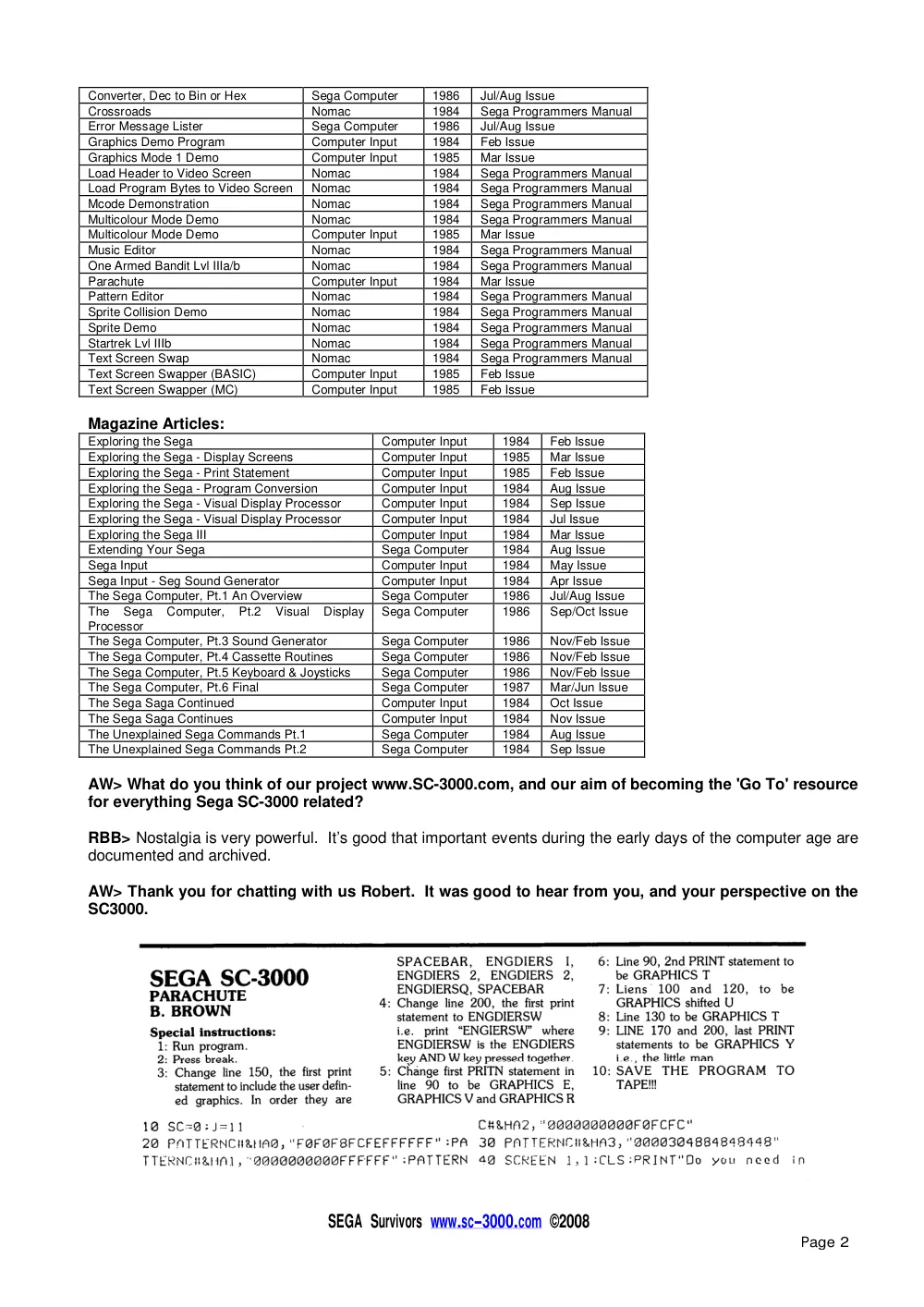
Parachute
Computer Input
1984
Mar Issue
Pattern Editor
Nomac
1984
Sega Programmers Manual
Sprite Collision Demo
Nomac
1984
Sega Programmers Manual
Sprite Demo
Nomac
1984
Sega Programmers Manual
Startrek Lvl IIIb
Nomac
1984
Sega Programmers Manual
Text Screen Swap
Nomac
1984
Sega Programmers Manual
Text Screen Swapper (BASIC)
Computer Input
1985
Feb Issue
Text Screen Swapper (MC)
Computer Input
1985
Feb Issue
Magazine Articles:
Exploring the Sega
Computer Input
1984
Feb Issue
Exploring the Sega - Display Screens
Computer Input
1985
Mar Issue
Exploring the Sega - Print Statement
Computer Input
1985
Feb Issue
Exploring the Sega - Program Conversion
Computer Input
1984
Aug Issue
Exploring the Sega - Visual Display Processor
Computer Input
1984
Sep Issue
Exploring the Sega - Visual Display Processor
Computer Input
1984
Jul Issue
Exploring the Sega III
Computer Input
1984
Mar Issue
Extending Your Sega
Sega Computer
1984
Aug Issue
Sega Input
Computer Input
1984
May Issue
Sega Input - Seg Sound Generator
Computer Input
1984
Apr Issue
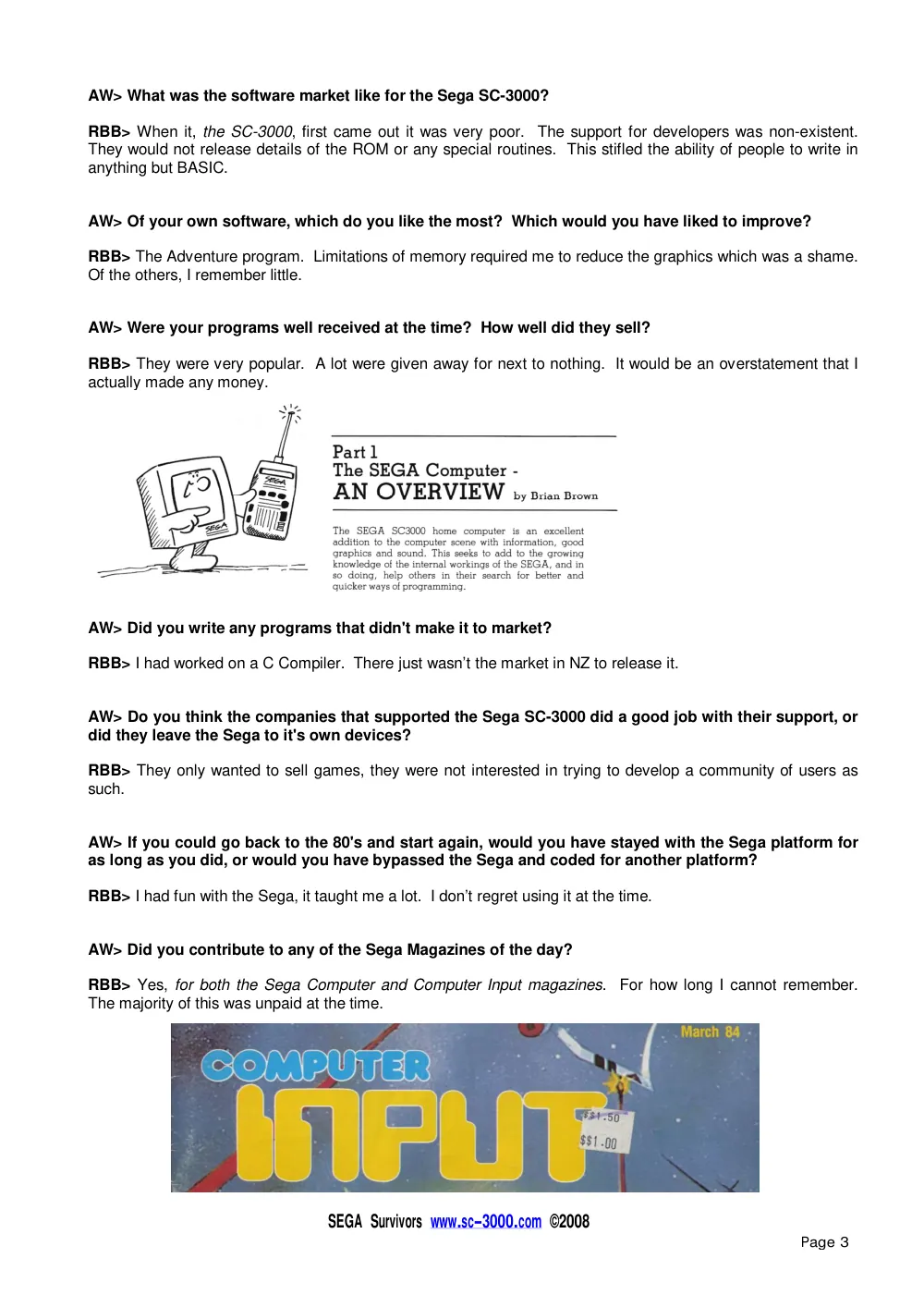
The Sega Computer, Pt.1 An Overview
Sega Computer
1986
Jul/Aug Issue
The
Sega
Computer,
Pt.2
Visual
Display
Processor
Sega Computer
1986
Sep/Oct Issue
The Sega Computer, Pt.3 Sound Generator
Sega Computer
1986
Nov/Feb Issue
The Sega Computer, Pt.4 Cassette Routines
Sega Computer
1986
Nov/Feb Issue
The Sega Computer, Pt.5 Keyboard & Joysticks
Sega Computer
1986
Nov/Feb Issue
The Sega Computer, Pt.6 Final
Sega Computer
1987
Mar/Jun Issue
The Sega Saga Continued
Computer Input
1984
Oct Issue
The Sega Saga Continues
Computer Input
1984
Nov Issue
The Unexplained Sega Commands Pt.1
Sega Computer
1984
Aug Issue
The Unexplained Sega Commands Pt.2
Sega Computer
1984
Sep Issue
AW> What do you think of our project www.SC-3000.com, and our aim of becoming the 'Go To' resource
for everything Sega SC-3000 related?
RBB> Nostalgia is very powerful. It’s good that important events during the early days of the computer age are
documented and archived.
AW> Thank you for chatting with us Robert. It was good to hear from you, and your perspective on the
SC3000.
5 / 5

![Brian Brown — from the work: Robert B. Brown [aka Brian Brown], author of the Sega Programming Manual and numerous Grandstand program’s for SEGA SC-3000.](/interviews/interview-with-brian-brown/BB_artwork.jpg "Brian Brown — from the work: Robert B. Brown [aka Brian Brown], author of the Sega Programming Manual and numerous Grandstand program’s for SEGA SC-3000.")