SEGA Survivors www.sc-3000.com ©2008
Page 1
An Interview with Dean Hodgson
Programmer of many educational titles
released by John Sands for the SEGA SC-3000.
Date of Interview: 26th June to 14th July 2008
Interviewer: Aaron Wheeler
AW> It’s good to catch up with you Dean, can you start by telling us a bit about
your background in computing in general.
DH> I learned how to write programs in Fortran in 1969 when I was in high school,
north of Seattle. They were sent on punch cards to the school district's IBM 1401
computer, and a huge stack of paper would be returned if there was an error, but if it
worked, you might get one or two pages. A year later the university I was at gave me
time on their IBM 360. I learned their home-grown WPL language. I didn't use
computers for years after that until 1978. By then, I was teaching primary school in
Port Pirie, South Australia, a country town located about 250 km north of Adelaide. I
discovered that a HP 9830 desktop computer that floated between the three high
schools there. I taught myself how to program it and I wrote two pieces that I'd been
wanting to write for a long time: a program based on Jay Forrester's published World
Dynamics code that projected the future of the Earth in terms of resource usage,
population growth, pollution, etc, and another program that simulated the formation of planets using info from an
article by Stephen Dole that had appeared in the Icarus astronomy journal. I wanted to see what the affects of
space colonization might have on the future, and I wanted to calculate reasonable probabilities of finding
different types of planets around different types of stars by modifying Dole's program. Not riveting stuff for most
but I was able to present a revised version of the latter program at a large meeting of the South Australian
Astronomical Society in 1990.
In 1979 I bought a Tandy Model 1, taught myself its Basic and started writing original programs. It had a
whopping 4k of memory which I quickly upgraded to 16k. I wrote a pile of little programs including several of my
own text-based adventure games, which I spread around Pirie and Adelaide via contacts . I brought this
machine to school and had to write programs so my students could use it, there just wasn't any good learning
software about then. I researched Computer Assisted Instruction (CAI) and made sure my programs were
based on those learning principals. Early in '82 the school bought two Tandy Color Computers. I wrote a few
dozen programs for this system for the entire school to use. The graphics were all hard-coded and I used
stacks of graph paper designing images. For one project, the children in my year 5 class designed a computer
game from scratch, including drawing the graphics, and it was published in "Australian Rainbow" magazine.
Later, I submitted and sold three of the classroom programs to Tandy Australia. Their rep flew all the way from
Sydney to Pirie for a week to see me. They bought 3 of my programs -- Maths Invaders, Spelling and Cordial
Stall, and for awhile in 1983 they were the highest selling pieces of software in Tandy's catalogue. I also wrote
a monthly column for the magazine, too. Another program I wrote for the school managed its library. Little did I
know what seed that planted!
This brings us up to early 1983. I branched out and bought a VIC-20, which to me was unimpressive and
difficult to program, so I didn't do much with it.
AW> How did you get involved with programming the SEGA SC-3000?
DH> In 83, I was interested in the new MSX standard and I saw an ad for the then-
new SEGA SC-3000 in Australian Personal Computing magazine. The SEGA wasn't
MSX but it had similar hardware and sounded interesting, so I wrote a letter to JSE
(John Sands Electronics) telling them about the programs I'd sold to Tandy and were
they interested in me writing versions for them? Yes, indeed they were. From that
correspondence, we agreed that I would write four simple arcade-style math games
along with my original Spelling tutor and Cordial Stall, which was a little business
program and unoriginal, and a problem solving suite for young children called
Creature Features. I had already written all of these on the Coco, so it was a job of
converting them and improving the graphics and sounds. I purchased a SC-3000
Dean Hodgson
1 / 5
SEGA Survivors www.sc-3000.com ©2008
Page 2
with a cassette drive and plugged it into my little Sharp portable TV (which I still have and which still works
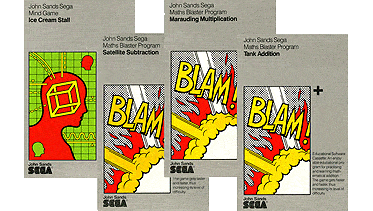
well!!). I versioned Maths Invaders (Marauding Multiplication) first. JSE preferred a separate program for each
maths operation rather than one that did all four, and I had written these on the CoCo anyway, so I also
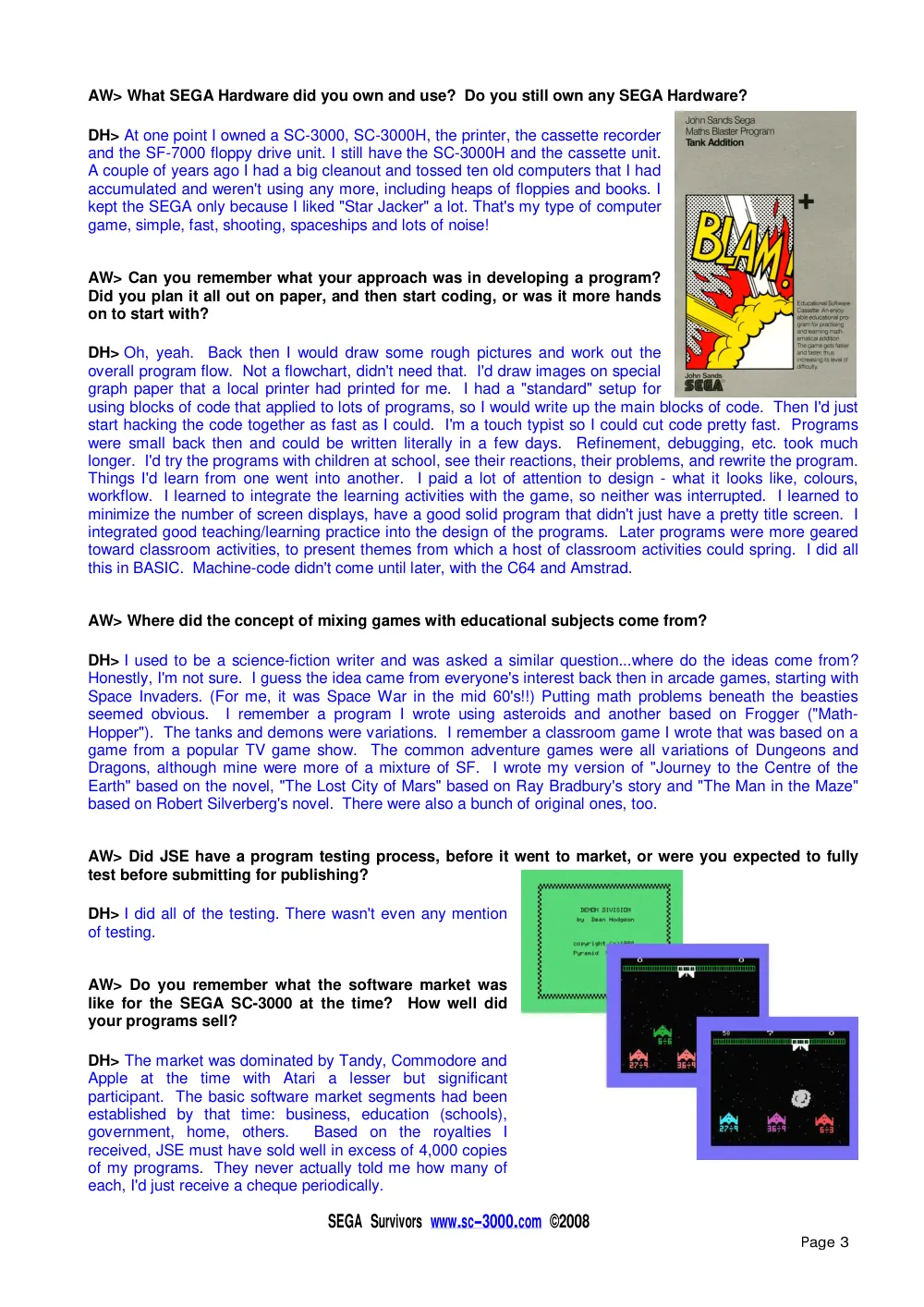
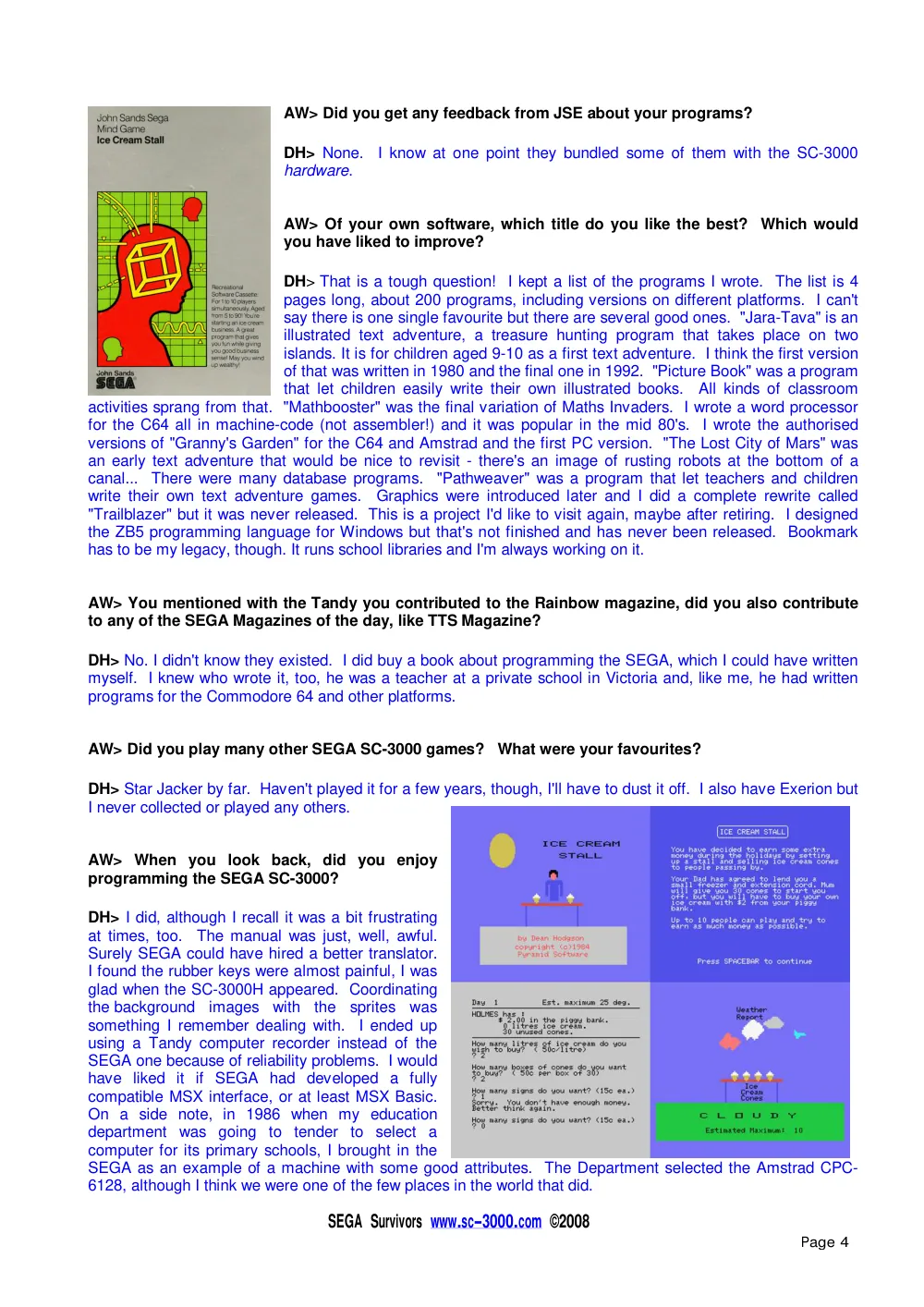
versioned Tank Addition, Demon Division, Satellite Subtraction, Ice Cream Stall and Spelling. The last was a
straight CAI program that followed the rules strictly. A lot of research went into the word list and the learning
process. I know these programs worked because I had done testing with many children, even a control group.
JSE bought these from me and paid a royalty for each copy they sold. It turned out to be well in excess of 4,000
copies over the next couple of years. I was married in late August 84, and JSE invited us to visit while we were
in Melbourne on our honeymoon. We were taken to a French restaurant. The JSE manager was nice (sorry I
cannot recall his name), he was very interested in the home education market, he had some big ideas and he
listened to some I had. I saw the "new" hard drive box. There is a photo somewhere of me and my 2nd wife just
off the plane at Adelaide and I have a box with a SC-3000H under my arm that I had been given. I wrote CF
(Creature Features) and sent it off but by the time it was finished, the staff at JSE had changed and they never
got back to me about it. Communication pretty much stopped and that was that. I wrote one extra little program
for Melbourne Cup day with racing-horse sprites and music that sounded like it had come from Blade Runner.
That would have been the end of 1984.
AW> John Sands Electronics played a the major role in getting the SEGA SC-3000 off the ground in
Australia, what else can you tell us about them and your interaction with them?
DH> The original manager was very interested in the home education market. Mostly, it was via
correspondence and that one visit. I can't recall if we even spoke via phone. So there isn't much I can tell you
about them. I recall the warehouse down near the Melbourne waterfront. They had hired a young programmer
who was getting to know the "new" floppy drive box. I got the impression that after the management changed,
JSE was mainly interested in selling imported games.
AW> Can you tell us more about the Creature
Features program that didn’t make it to
market?
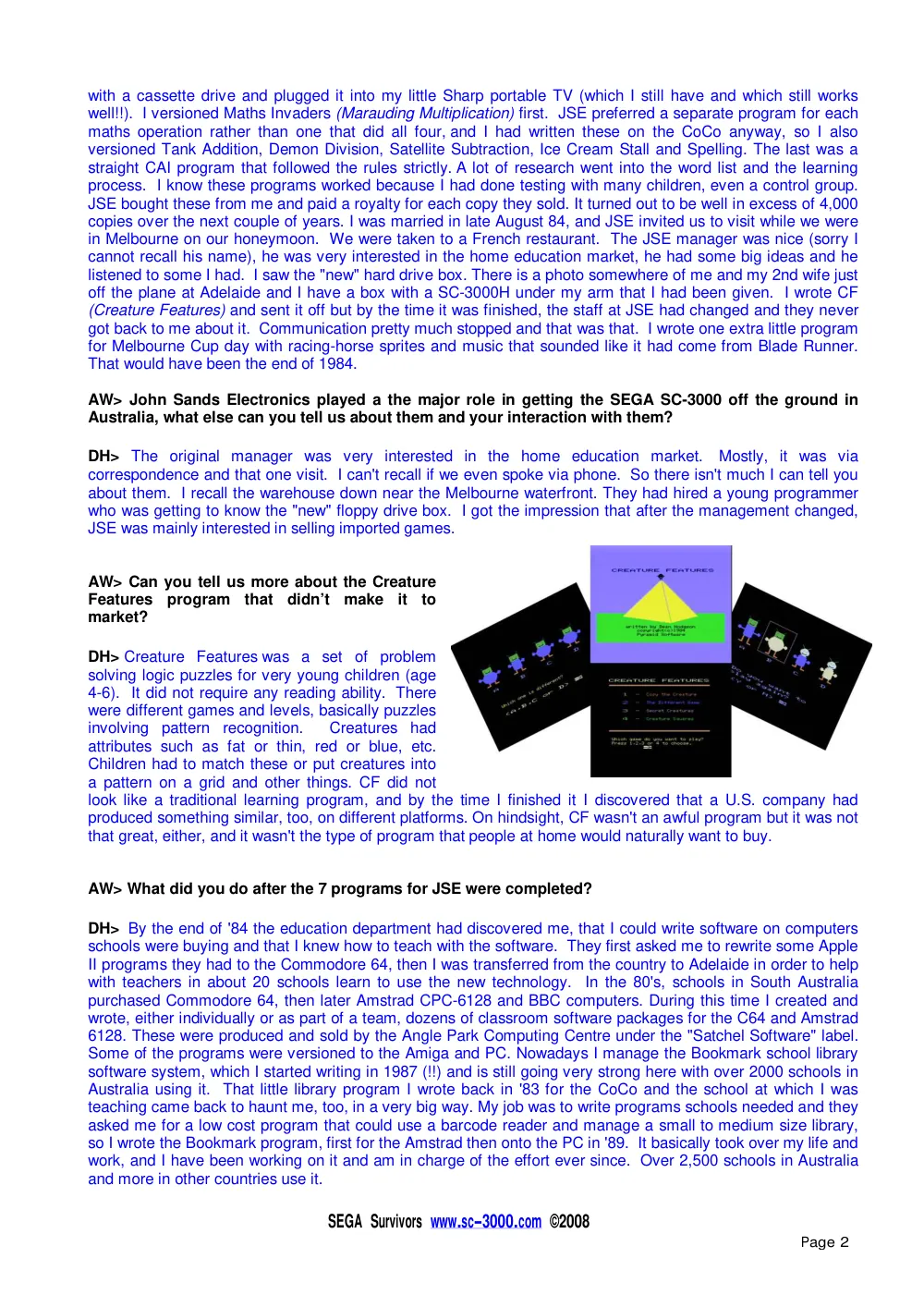
DH> Creature Features was a set of problem
solving logic puzzles for very young children (age
4-6). It did not require any reading ability. There
were different games and levels, basically puzzles
involving pattern recognition. Creatures had
attributes such as fat or thin, red or blue, etc.
Children had to match these or put creatures into
a pattern on a grid and other things. CF did not
look like a traditional learning program, and by the time I finished it I discovered that a U.S. company had
produced something similar, too, on different platforms. On hindsight, CF wasn't an awful program but it was not
that great, either, and it wasn't the type of program that people at home would naturally want to buy.
AW> What did you do after the 7 programs for JSE were completed?
DH> By the end of '84 the education department had discovered me, that I could write software on computers
schools were buying and that I knew how to teach with the software. They first asked me to rewrite some Apple
II programs they had to the Commodore 64, then I was transferred from the country to Adelaide in order to help
with teachers in about 20 schools learn to use the new technology. In the 80's, schools in South Australia
purchased Commodore 64, then later Amstrad CPC-6128 and BBC computers. During this time I created and
wrote, either individually or as part of a team, dozens of classroom software packages for the C64 and Amstrad
6128. These were produced and sold by the Angle Park Computing Centre under the "Satchel Software" label.
Some of the programs were versioned to the Amiga and PC. Nowadays I manage the Bookmark school library
software system, which I started writing in 1987 (!!) and is still going very strong here with over 2000 schools in
Australia using it. That little library program I wrote back in '83 for the CoCo and the school at which I was
teaching came back to haunt me, too, in a very big way. My job was to write programs schools needed and they
asked me for a low cost program that could use a barcode reader and manage a small to medium size library,
so I wrote the Bookmark program, first for the Amstrad then onto the PC in '89. It basically took over my life and
work, and I have been working on it and am in charge of the effort ever since. Over 2,500 schools in Australia
and more in other countries use it.
2 / 5
SEGA Survivors www.sc-3000.com ©2008
Page 3
AW> What SEGA Hardware did you own and use? Do you still own any SEGA Hardware?
DH> At one point I owned a SC-3000, SC-3000H, the printer, the cassette recorder
and the SF-7000 floppy drive unit. I still have the SC-3000H and the cassette unit.
A couple of years ago I had a big cleanout and tossed ten old computers that I had
accumulated and weren't using any more, including heaps of floppies and books. I
kept the SEGA only because I liked "Star Jacker" a lot. That's my type of computer
game, simple, fast, shooting, spaceships and lots of noise!
AW> Can you remember what your approach was in developing a program?
Did you plan it all out on paper, and then start coding, or was it more hands
on to start with?
DH> Oh, yeah. Back then I would draw some rough pictures and work out the
overall program flow. Not a flowchart, didn't need that. I'd draw images on special
graph paper that a local printer had printed for me. I had a "standard" setup for
using blocks of code that applied to lots of programs, so I would write up the main blocks of code. Then I'd just
start hacking the code together as fast as I could. I'm a touch typist so I could cut code pretty fast. Programs
were small back then and could be written literally in a few days. Refinement, debugging, etc. took much
longer. I'd try the programs with children at school, see their reactions, their problems, and rewrite the program.
Things I'd learn from one went into another. I paid a lot of attention to design - what it looks like, colours,
workflow. I learned to integrate the learning activities with the game, so neither was interrupted. I learned to
minimize the number of screen displays, have a good solid program that didn't just have a pretty title screen. I
integrated good teaching/learning practice into the design of the programs. Later programs were more geared
toward classroom activities, to present themes from which a host of classroom activities could spring. I did all
this in BASIC. Machine-code didn't come until later, with the C64 and Amstrad.
AW> Where did the concept of mixing games with educational subjects come from?
DH> I used to be a science-fiction writer and was asked a similar question...where do the ideas come from?
Honestly, I'm not sure. I guess the idea came from everyone's interest back then in arcade games, starting with
Space Invaders. (For me, it was Space War in the mid 60's!!) Putting math problems beneath the beasties
seemed obvious. I remember a program I wrote using asteroids and another based on Frogger ("Math-
Hopper"). The tanks and demons were variations. I remember a classroom game I wrote that was based on a
game from a popular TV game show. The common adventure games were all variations of Dungeons and
Dragons, although mine were more of a mixture of SF. I wrote my version of "Journey to the Centre of the
Earth" based on the novel, "The Lost City of Mars" based on Ray Bradbury's story and "The Man in the Maze"
based on Robert Silverberg's novel. There were also a bunch of original ones, too.
AW> Did JSE have a program testing process, before it went to market, or were you expected to fully
test before submitting for publishing?
DH> I did all of the testing. There wasn't even any mention
of testing.
AW> Do you remember what the software market was
like for the SEGA SC-3000 at the time? How well did
your programs sell?
DH> The market was dominated by Tandy, Commodore and
Apple at the time with Atari a lesser but significant
participant. The basic software market segments had been
established by that time: business, education (schools),
government, home, others. Based on the royalties I
received, JSE must have sold well in excess of 4,000 copies
of my programs. They never actually told me how many of
each, I'd just receive a cheque periodically.
3 / 5
SEGA Survivors www.sc-3000.com ©2008
Page 4
AW> Did you get any feedback from JSE about your programs?
DH> None. I know at one point they bundled some of them with the SC-3000
hardware.
AW> Of your own software, which title do you like the best? Which would
you have liked to improve?
DH> That is a tough question! I kept a list of the programs I wrote. The list is 4
pages long, about 200 programs, including versions on different platforms. I can't
say there is one single favourite but there are several good ones. "Jara-Tava" is an
illustrated text adventure, a treasure hunting program that takes place on two
islands. It is for children aged 9-10 as a first text adventure. I think the first version
of that was written in 1980 and the final one in 1992. "Picture Book" was a program
that let children easily write their own illustrated books. All kinds of classroom
activities sprang from that. "Mathbooster" was the final variation of Maths Invaders. I wrote a word processor
for the C64 all in machine-code (not assembler!) and it was popular in the mid 80's. I wrote the authorised
versions of "Granny's Garden" for the C64 and Amstrad and the first PC version. "The Lost City of Mars" was
an early text adventure that would be nice to revisit - there's an image of rusting robots at the bottom of a
canal... There were many database programs. "Pathweaver" was a program that let teachers and children
write their own text adventure games. Graphics were introduced later and I did a complete rewrite called
"Trailblazer" but it was never released. This is a project I'd like to visit again, maybe after retiring. I designed
the ZB5 programming language for Windows but that's not finished and has never been released. Bookmark
has to be my legacy, though. It runs school libraries and I'm always working on it.
AW> You mentioned with the Tandy you contributed to the Rainbow magazine, did you also contribute
to any of the SEGA Magazines of the day, like TTS Magazine?
DH> No. I didn't know they existed. I did buy a book about programming the SEGA, which I could have written
myself. I knew who wrote it, too, he was a teacher at a private school in Victoria and, like me, he had written
programs for the Commodore 64 and other platforms.
AW> Did you play many other SEGA SC-3000 games? What were your favourites?
DH> Star Jacker by far. Haven't played it for a few years, though, I'll have to dust it off. I also have Exerion but
I never collected or played any others.
AW> When you look back, did you enjoy
programming the SEGA SC-3000?
DH> I did, although I recall it was a bit frustrating
at times, too. The manual was just, well, awful.
Surely SEGA could have hired a better translator.
I found the rubber keys were almost painful, I was
glad when the SC-3000H appeared. Coordinating
the background images with the sprites was
something I remember dealing with. I ended up
using a Tandy computer recorder instead of the
SEGA one because of reliability problems. I would
have liked it if SEGA had developed a fully
compatible MSX interface, or at least MSX Basic.
On a side note, in 1986 when my education
department was going to tender to select a
computer for its primary schools, I brought in the
SEGA as an example of a machine with some good attributes. The Department selected the Amstrad CPC-
6128, although I think we were one of the few places in the world that did.
4 / 5
SEGA Survivors www.sc-3000.com ©2008
Page 5
AW> Can you list for us all the SEGA SC-3000 programs you were involved with?
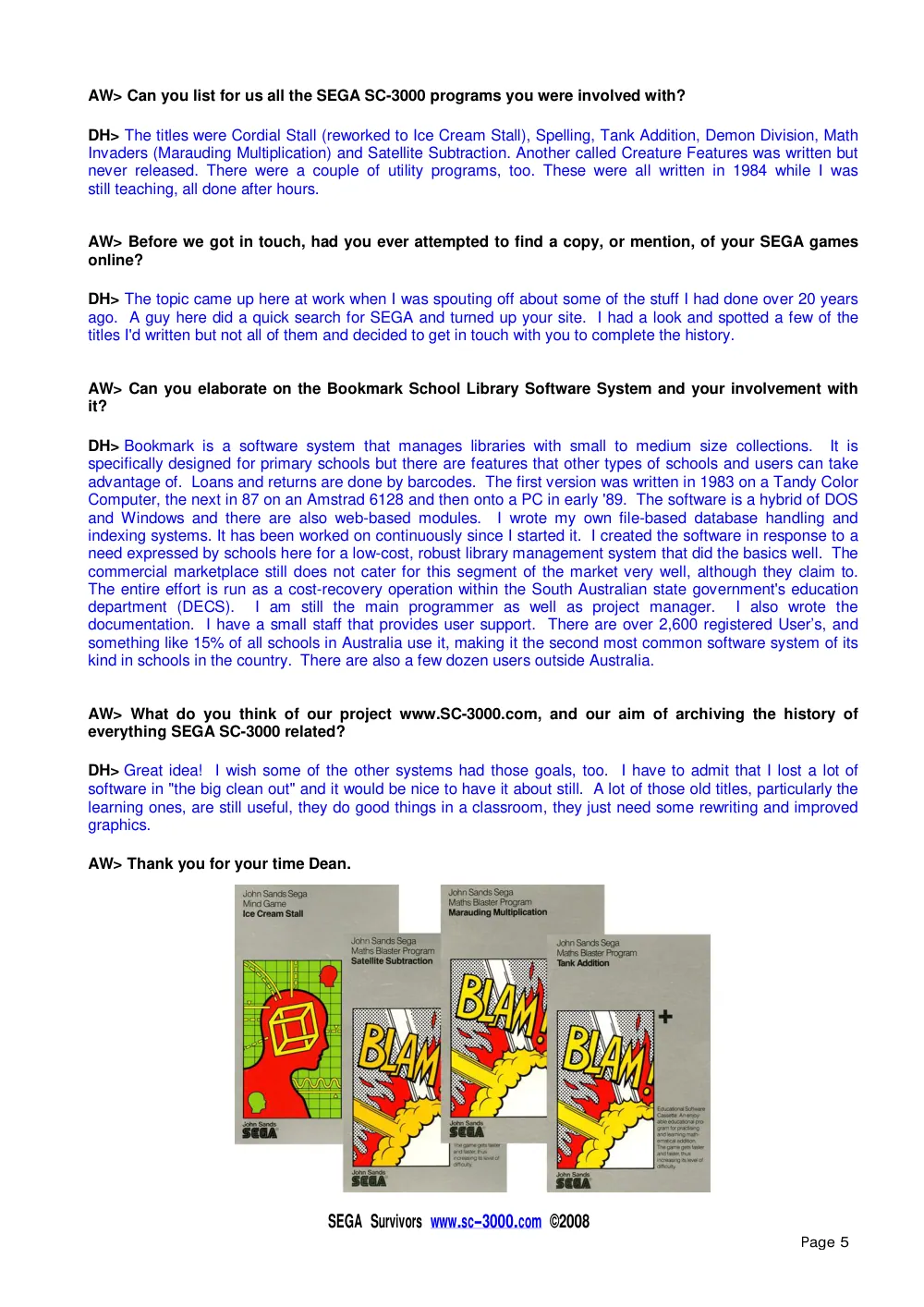
DH> The titles were Cordial Stall (reworked to Ice Cream Stall), Spelling, Tank Addition, Demon Division, Math
Invaders (Marauding Multiplication) and Satellite Subtraction. Another called Creature Features was written but
never released. There were a couple of utility programs, too. These were all written in 1984 while I was
still teaching, all done after hours.
AW> Before we got in touch, had you ever attempted to find a copy, or mention, of your SEGA games
online?
DH> The topic came up here at work when I was spouting off about some of the stuff I had done over 20 years
ago. A guy here did a quick search for SEGA and turned up your site. I had a look and spotted a few of the
titles I'd written but not all of them and decided to get in touch with you to complete the history.
AW> Can you elaborate on the Bookmark School Library Software System and your involvement with
it?
DH> Bookmark is a software system that manages libraries with small to medium size collections. It is
specifically designed for primary schools but there are features that other types of schools and users can take
advantage of. Loans and returns are done by barcodes. The first version was written in 1983 on a Tandy Color
Computer, the next in 87 on an Amstrad 6128 and then onto a PC in early '89. The software is a hybrid of DOS
and Windows and there are also web-based modules. I wrote my own file-based database handling and
indexing systems. It has been worked on continuously since I started it. I created the software in response to a
need expressed by schools here for a low-cost, robust library management system that did the basics well. The
commercial marketplace still does not cater for this segment of the market very well, although they claim to.
The entire effort is run as a cost-recovery operation within the South Australian state government's education
department (DECS). I am still the main programmer as well as project manager. I also wrote the
documentation. I have a small staff that provides user support. There are over 2,600 registered User’s, and
something like 15% of all schools in Australia use it, making it the second most common software system of its
kind in schools in the country. There are also a few dozen users outside Australia.
AW> What do you think of our project www.SC-3000.com, and our aim of archiving the history of
everything SEGA SC-3000 related?
DH> Great idea! I wish some of the other systems had those goals, too. I have to admit that I lost a lot of
software in "the big clean out" and it would be nice to have it about still. A lot of those old titles, particularly the
learning ones, are still useful, they do good things in a classroom, they just need some rewriting and improved
graphics.
AW> Thank you for your time Dean.
5 / 5