SEGA Survivors www.sc-3000.com ©2012 (1/5)
Let’s start with our standard opening question Why a SEGA SC-3000 and not one of the
other more popular computer systems of the time such as a Commodore,
Spectrum or Apple?
My first computer was a Commodore Vic 20. I wanted a ZX81 but they
had run out of stock locally. I wrote a game for the Vic 20 and tried to
sell them through a local computer store, but it was a text adventure
written in BASIC, and they weren't interested. I am not sure why I chose
the Sega, but I think I saw the opportunity to write for a computer that
wasn't well supported for software at the time.
Your games were a level above the other cassette software available for the SC-3000,
describe for us your programming background at the time, your mentors, collaborators and
how did the development and release of your first completed product come about?
I had some limited experience writing BASIC games for the Vic
20. I learnt machine code and emulated what was available for
other computers at the time. I had no mentors or collaborators; I
was just a teenager spending too much time in his room at his
computer. Burglar Bill was my first game. It was based on Manic
Miner for the Spectrum. I initially sold it through mail order then
Geoff at Poseidon Software asked if I was interested in marketing it through him.
What’s the story behind SegaMon? Was it a tool developed specifically for retail or was it
something you used for your own development that Poseidon caught wind of and suggested
it could be useful to other developers?
I wrote all my software in raw machine code, which was a mind-expanding
experience to say the least. I guess I thought someone might find it useful. I never
used it myself.
Can you describe for us the process, techniques and other tools you used during design,
development and testing?
I started with an idea, and built it up screen by screen. There was no formal
process. I designed everything myself, using inspiration from other games
available at the time. I think I am quite a thorough and persevering type of
person, so I put a lot of time and effort into making sure everything worked as I
expected.
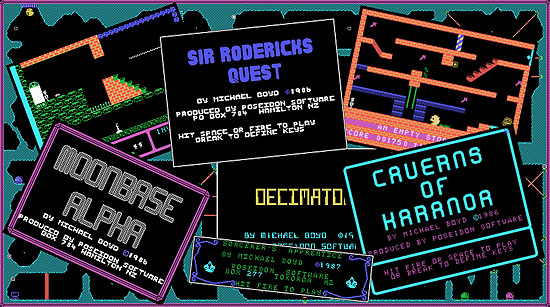
SC-3000 Celebrity : Michael Boyd
Notable Work : Burglar Bill, Caverns Of Karanor, Segamon,
Sir Roderick’s Quest, Sorcerer’s Apprentice,
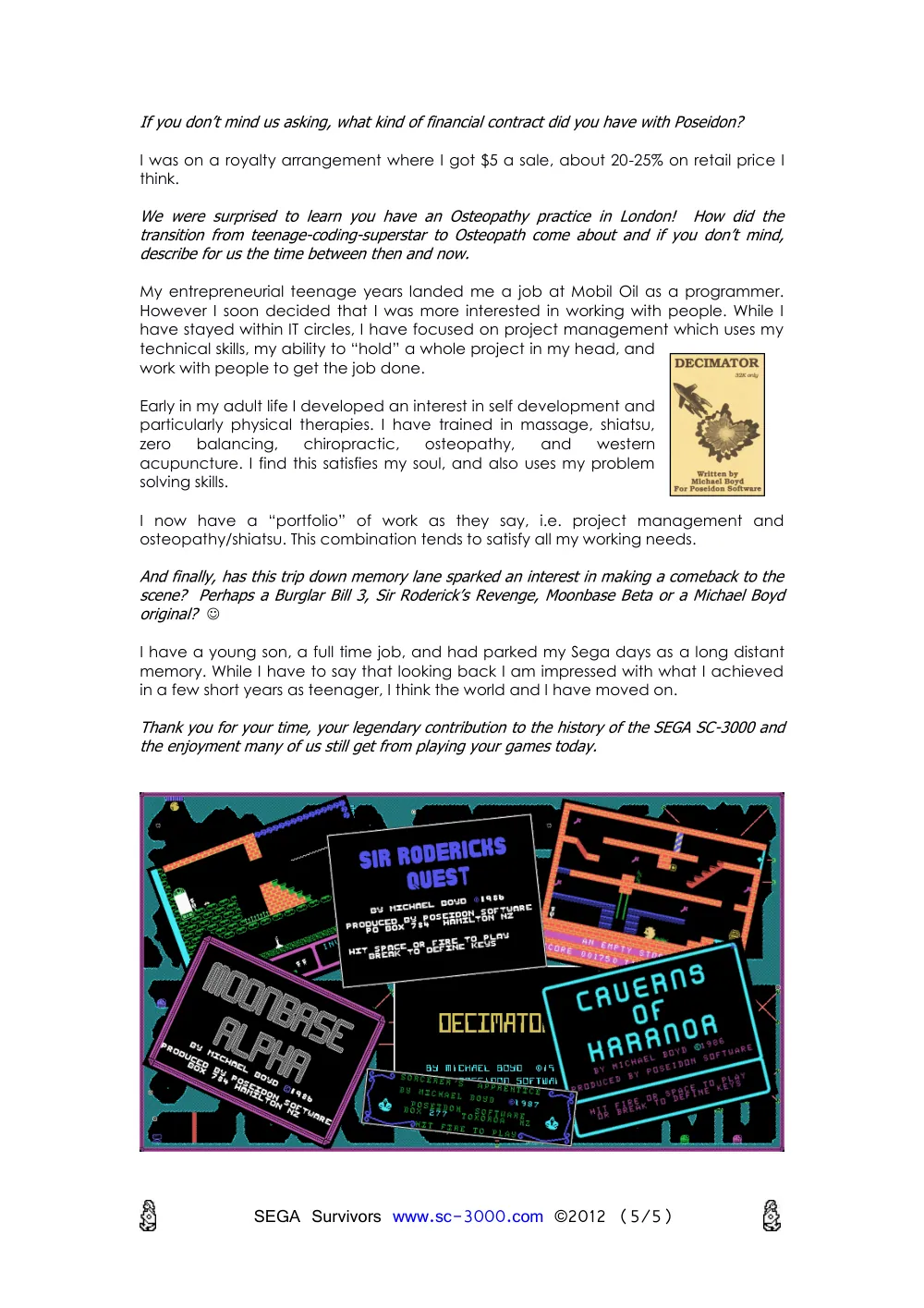
Moonbase Alpha, Decimator
Interview Date : April 2012
1 / 5
SEGA Survivors www.sc-3000.com ©2012 (2/5)
What reference materials did you have to help understand and utilise the SC-3000 Hardware
and Basic ROM routines or did you disassemble the ROM routines yourself?
I only had what was available in the local Sega media. Sega magazines were
particularly helpful. I did disassemble some routines myself, but I just used what
information was available at the time.
Where did you get the idea for the micro-loaders from? There
are earlier examples of filename morphing protection such as
embedded control characters but we believe Burglar Bill was the
first micro-loader with 'RUN' as the filename and no BASIC
listing. We suspect you were also the first to use the technique
of loading tiles directly to VRAM which is far more efficient than
the common alternative of implementing a BASIC routine to POKE data/Z80 code into
memory.
I started by using BASIC as a means of loading code, but as you say it wasn't efficient
and not suitable for large games. I had seen loaders used on other computers such
as the Commodore 64 and ZX Spectrum. It was probably borne out of necessity in
part, but it was also the challenge and satisfaction of controlling the whole process. I
remember naming one of my loaders SEFEL, which I was particularly pleased with,
although I don't know what it’s short for now.
Parallels have been drawn between your games and those available for other systems such
as Burglar Bill vs Manic Miner, Caverns Of Karanor vs Jet Set Willy and Sir Roderick’s Quest vs
Sceptre Of Bagdad, Spellbound or Stormbringer. Where did the inspiration for your games
come from and were there designs you didn’t get around to developing?
All my ideas were based on similar games for other computers at the time. I think Sir
Roderick's Quest was partly inspired by Tir Na Nog, which impressed me. I was always
trying to create a virtual world to immerse the player in. I came to the
limits of my design expertise when trying to create 3D landscapes for
a game inspired by Lords of Midnight, so this never got further than
the concept stage. I think this was the time when I stopped writing
games, partly because I was struggling to achieve what I wanted to
create, and partly because my life was moving on; university and a
social life....
The demand for my games was also dropping. Burglar Bill was the
biggest seller, so it probably hit the market at its peak. Later games didn't sell
anywhere near as well. By the end of the 1980's sales had dropped to almost nothing.
Based on how Glen Mackie was able to track you down, it appears the
“Skidge” entry in the Burglar Bill highscore table came from your classmate
Skidge
Mackle.
As
well
as
being
friends,
did
he
assist
your
development/testing in any way?
My friend played the games once or twice and probably gave some
feedback on occasions, but he was busy being a normal teenager
rather than stuck in a bedroom being antisocial and developing RSI like
I was.
2 / 5
SEGA Survivors www.sc-3000.com ©2012 (3/5)
Moonbase Alpha is one of two SC-3000 titles to feature digitised speech, Vortex Blaster the
other, how did you figure out how to do it? Did you use the SC-3000 cassette-in port or the
SEGA Speech Synthesizer for the digitizing and is it your voice we can hear and did you
compose the intro music yourself?
I don't know for sure how I worked out how to do it, but I didn't have the
synthesizer. I vaguely remember looking at Vortex Blaster to see how it was
done on this game, but to be honest it’s a bit of a guess. I'm not sure if the
voice is mine or my friend's. I had an electronic keyboard which may have helped
with the intro music, although I'd be the first to admit it’s pretty bad!
At the time of its release, Sir Roderick’s Quest set a new standard for, and raised
expectations of, what could be accomplished on the SEGA SC-3000 with a 32k BASIC
cartridge. How did your own expectations change following the success and feedback
compared to previous releases and what do you remember of developing SRQ?
I don't remember receiving much in the way of feedback. Geoff at
Poseidon Software was always very supportive and encouraging. A
review of one of my games in an Australian magazine was very
positive except for the soundtrack, which encouraged me to improve
on this in later games. I also received a Bits & Bytes software award for
Caverns of Karanor in 1987.
I think with every new game (except Decimator which was an
attempt to do something different) I was trying to create a more realistic world in
which to immerse the player. You can see this with SRQ and SA. It was probably a
form of escapism on my part.
I made use of unused video ram for data storage in SA, possibly also in SRQ. This gave
me more memory to play with.
Sorcerer’s Apprentice raised the bar even higher by offering
more screens, more complex enemy artificial intelligence and
more complex game interaction with the collecting of currency
to purchase spells and boat tickets in order to progress through
the game. Considering the sheer size of the game, what kind of
decisions do you remember having to make to allow gamers a
chance of completing it without the ability to save their
progress? Did the same considerations affect your design of
other titles?
I can only say I was aware of making sure the games could be completed. So I tested
by completing them myself. With Caverns of Karanor I had to make it as difficult as
possible, while also ensuring it could be completed, because of the prize that was
given on completion. I also made a real effort to hide the code that was required to
secure the prize so you couldn't cheat. I'm not sure how successful this was, but two
people did win the prize.
Aside from Burglar Bill II which was more of a level expansion, Decimator was your final
release and also an interesting departure from your usual arcade-
adventure fare, was Defender a personal favourite of yours and a game
you wanted to pay tribute to in your own way?
I remember watching people play Defender in the arcades in my
early teens, although I didn't play it myself as it seemed too hard.
With Decimator I was looking to create something different from
3 / 5
SEGA Survivors www.sc-3000.com ©2012 (4/5)
the games I had written previously. This was an opportunity and a challenge, to
recreate a game that had inspired me when I was younger.
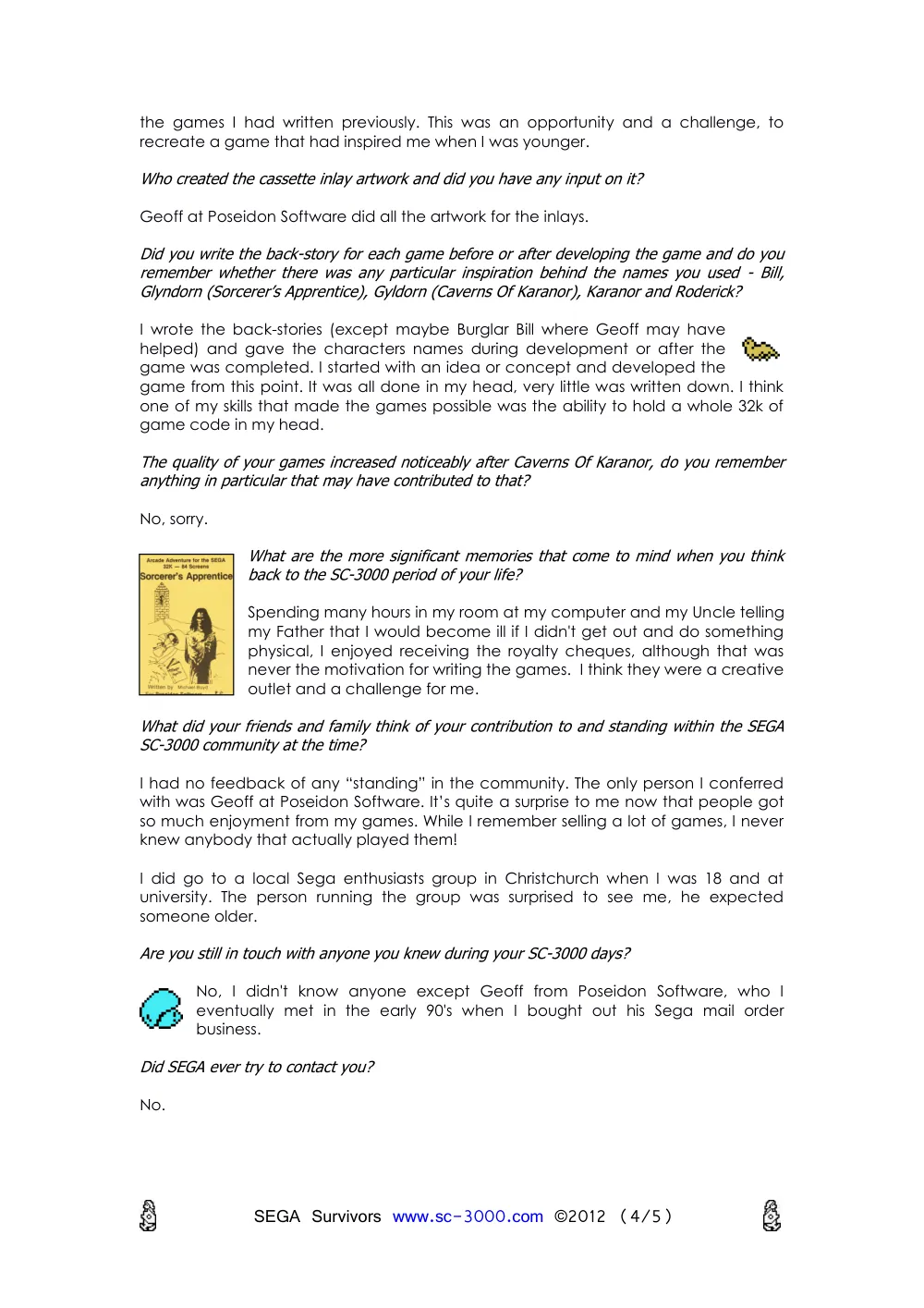
Who created the cassette inlay artwork and did you have any input on it?
Geoff at Poseidon Software did all the artwork for the inlays.
Did you write the back-story for each game before or after developing the game and do you
remember whether there was any particular inspiration behind the names you used - Bill,
Glyndorn (Sorcerer’s Apprentice), Gyldorn (Caverns Of Karanor), Karanor and Roderick?
I wrote the back-stories (except maybe Burglar Bill where Geoff may have
helped) and gave the characters names during development or after the
game was completed. I started with an idea or concept and developed the
game from this point. It was all done in my head, very little was written down. I think
one of my skills that made the games possible was the ability to hold a whole 32k of
game code in my head.
The quality of your games increased noticeably after Caverns Of Karanor, do you remember
anything in particular that may have contributed to that?
No, sorry.
What are the more significant memories that come to mind when you think
back to the SC-3000 period of your life?
Spending many hours in my room at my computer and my Uncle telling
my Father that I would become ill if I didn't get out and do something
physical, I enjoyed receiving the royalty cheques, although that was
never the motivation for writing the games. I think they were a creative
outlet and a challenge for me.
What did your friends and family think of your contribution to and standing within the SEGA
SC-3000 community at the time?
I had no feedback of any “standing” in the community. The only person I conferred
with was Geoff at Poseidon Software. It’s quite a surprise to me now that people got
so much enjoyment from my games. While I remember selling a lot of games, I never
knew anybody that actually played them!
I did go to a local Sega enthusiasts group in Christchurch when I was 18 and at
university. The person running the group was surprised to see me, he expected
someone older.
Are you still in touch with anyone you knew during your SC-3000 days?
No, I didn't know anyone except Geoff from Poseidon Software, who I
eventually met in the early 90's when I bought out his Sega mail order
business.
Did SEGA ever try to contact you?
No.
4 / 5
SEGA Survivors www.sc-3000.com ©2012 (5/5)
If you don’t mind us asking, what kind of financial contract did you have with Poseidon?
I was on a royalty arrangement where I got $5 a sale, about 20-25% on retail price I
think.
We were surprised to learn you have an Osteopathy practice in London! How did the
transition from teenage-coding-superstar to Osteopath come about and if you don’t mind,
describe for us the time between then and now.
My entrepreneurial teenage years landed me a job at Mobil Oil as a programmer.
However I soon decided that I was more interested in working with people. While I
have stayed within IT circles, I have focused on project management which uses my
technical skills, my ability to “hold” a whole project in my head, and
work with people to get the job done.
Early in my adult life I developed an interest in self development and
particularly physical therapies. I have trained in massage, shiatsu,
zero
balancing,
chiropractic,
osteopathy,
and
western
acupuncture. I find this satisfies my soul, and also uses my problem
solving skills.
I now have a “portfolio” of work as they say, i.e. project management and
osteopathy/shiatsu. This combination tends to satisfy all my working needs.
And finally, has this trip down memory lane sparked an interest in making a comeback to the
scene? Perhaps a Burglar Bill 3, Sir Roderick’s Revenge, Moonbase Beta or a Michael Boyd
original?
I have a young son, a full time job, and had parked my Sega days as a long distant
memory. While I have to say that looking back I am impressed with what I achieved
in a few short years as teenager, I think the world and I have moved on.
Thank you for your time, your legendary contribution to the history of the SEGA SC-3000 and
the enjoyment many of us still get from playing your games today.
5 / 5