SEGA Survivors www.sc-3000.com ©2008
Page 1
AK> You're definitely a celebrity in New Zealand SC-3000 circles but, for our
international readers, could you start by giving us a little background on your
involvement with the SEGA SC-3000 and why you got a SEGA SC-3000 instead of
one of the other, more popular computers of the time such as a Commodore,
Spectrum or Apple?
MH> I was at Auckland Uni in Auckland, New Zealand, and had always been interested in
computers. My dad saw an ad in the paper for SEGA programmers, and suggested I apply for
the job. Heck, why not?! So he and I wrote a synopsis of my background and I went for an
interview at Grandstand, the SEGA distributors in Newmarket, Auckland. I spoke mainly with
Grandstand’s Phil Kenyon. Phil showed me a list of programs that needed writing, and one
was a simple typing practice tool. I got the job doing programming work and tech support for
the SEGA SC-3000. I walked out of the interview with an SC-3000 and a very rough tech
document under my arm. That night I started playing around with sprites and sound!
AK> Did you own any computers prior and what have you owned since?
MH> Oh yeah – mainly a ZX-81! I learned Z80 assembly language on that thing, and I think
that’s what helped Kenyon decide to hire me.
AK> What additional SEGA hardware did you own?
MH> I had both joystick types and I had the SEGA monitor. That’s about it!
AK> What impressed you most about the SC-3000?
MH> It was very easy to program, especially in Z80 assembly.
AK> What do you think was the SC-3000’s biggest limitation?
MH> Software – that was the #1 issue by far. We were up against the likes of Atari and
Commodore who had a huge software base.
AK> What were the outstanding cartridges/cassettes/discs available for the SC-
3000 and what made them great?
MH> I never played any of the cartridge games. It’s not because I didn’t like any of them, it’s
mainly because I had no time and I knew that if I started a game I would not put it down.
Interviewer : Andrew Kerr (kerrjnr)
SC-3000 Celebrity : Michael Howard
Notable Work : The House
Help!
More Than 50 Programs For The SEGA SC-3000!!
Teach Yourself BASIC Games Programming
Interview Date : 3rd - 5th June 2008
1 / 4
SEGA Survivors www.sc-3000.com ©2008
Page 2
AK> From memory, were there any particular games that inspired you to write
your own games either for the SC-3000 or any other platform?
MH> I loved numerous games on the ZX Spectrum. For all of its weaknesses, it was a
stunning success because so much software was written for it. if there’s only one thing that
can be learned from this, it’s that software makes a platform. If you don’t have the software,
no matter how good the hardware is, you’re sunk. My favorite games are probably Elite (the
ZX Spectrum version was OK, but the Amstrad version rocked, as did the PC version) and
Knightlore (anything from Ultimate [now Rare], in fact!) on the Speccy.
AK> What was your programming background at the time and how did you adjust
to programming for the SC-3000?
MH> I was totally self taught, I just picked up a couple of books, read a bunch of magazines
and learned by doing. I’m a big fan of learning this way: pick something you want to do, and
write it. My favorite piece of code at the time was a game of Defender I wrote in Z80
assembly language on the ZX-81. A 1K ZX-81 :-)
AK> What was the most memorable piece of work you produced for the SC-3000
and why?
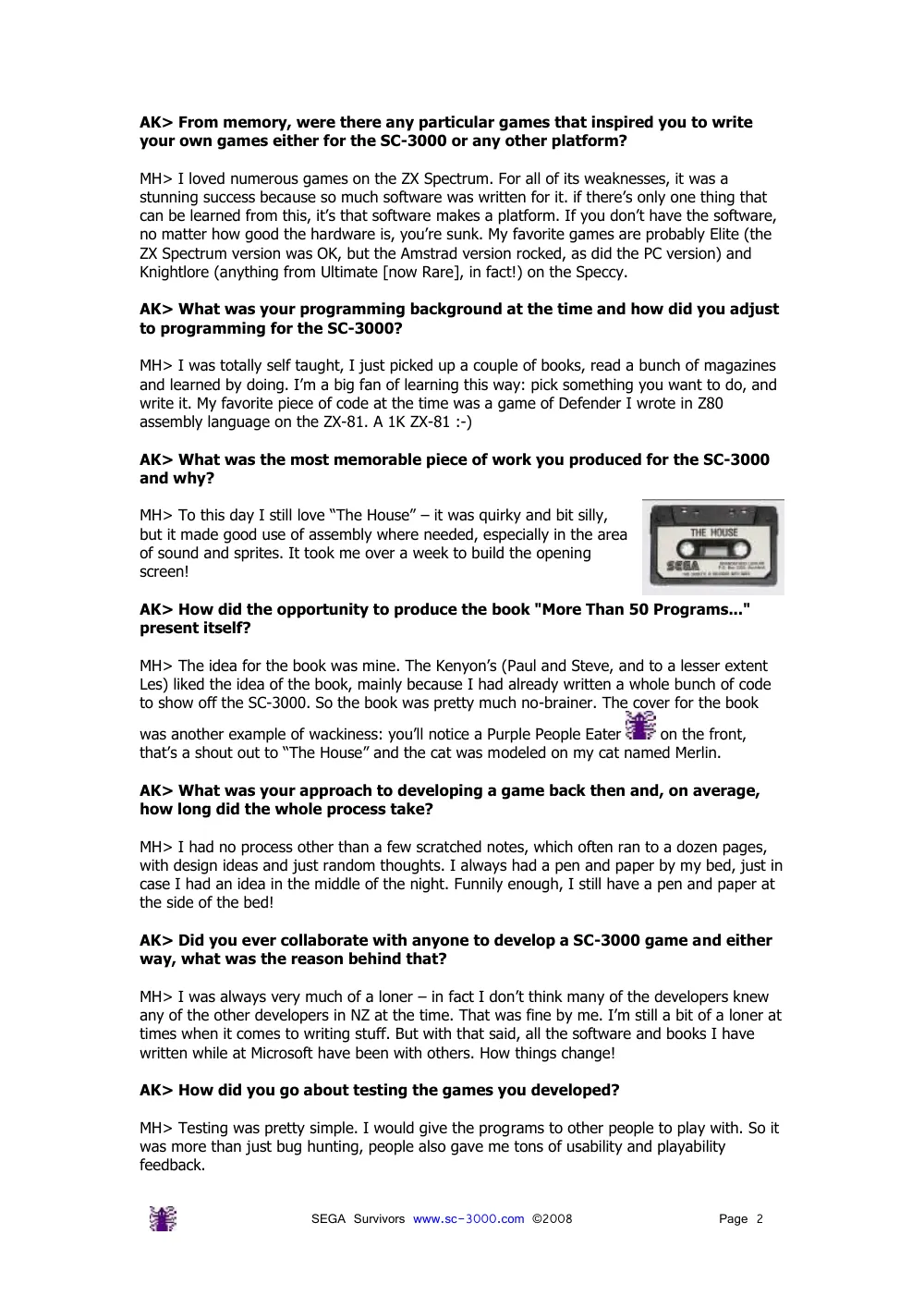
MH> To this day I still love “The House” – it was quirky and bit silly,
but it made good use of assembly where needed, especially in the area
of sound and sprites. It took me over a week to build the opening
screen!
AK> How did the opportunity to produce the book "More Than 50 Programs..."
present itself?
MH> The idea for the book was mine. The Kenyon’s (Paul and Steve, and to a lesser extent
Les) liked the idea of the book, mainly because I had already written a whole bunch of code
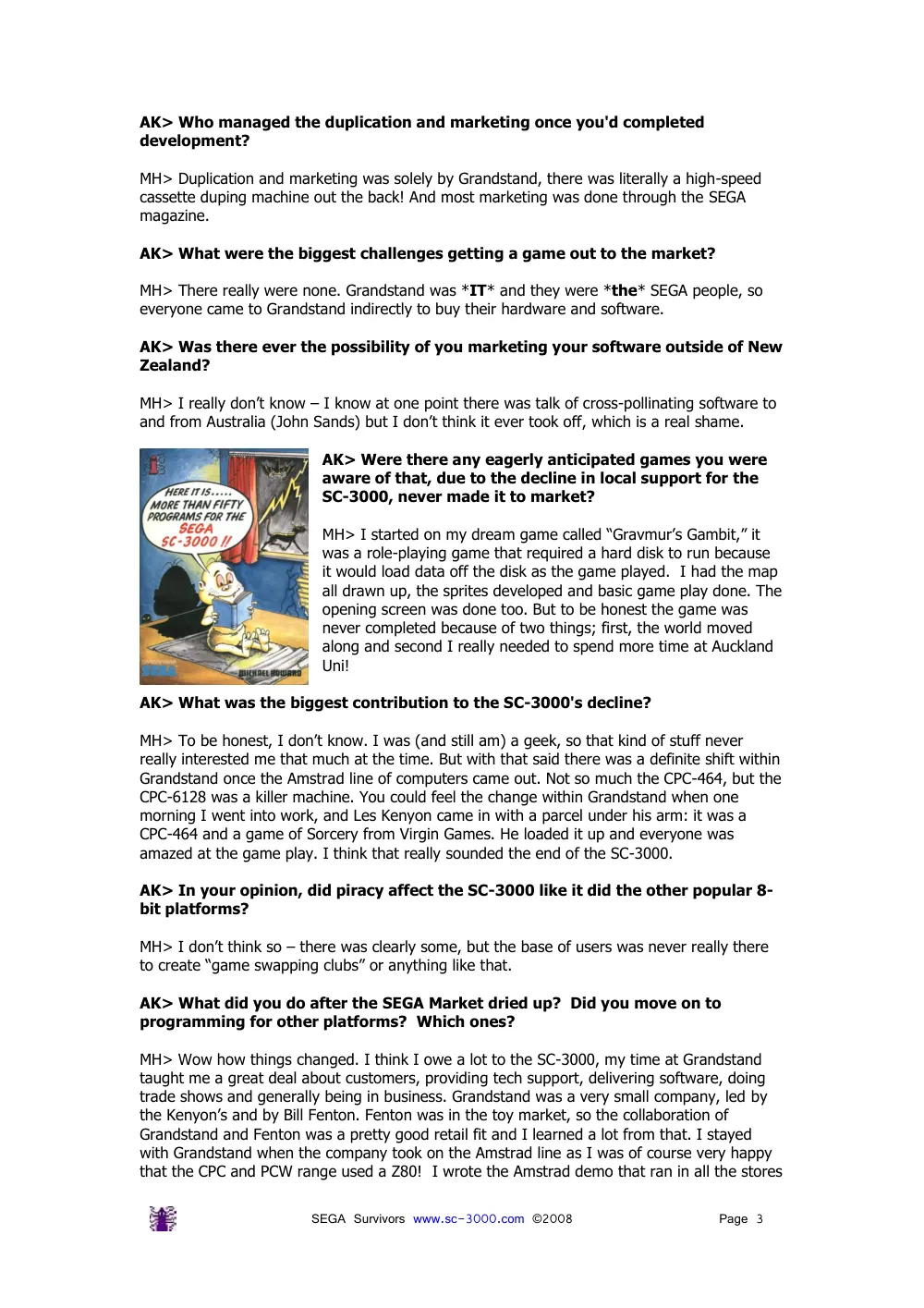
to show off the SC-3000. So the book was pretty much no-brainer. The cover for the book
was another example of wackiness: you’ll notice a Purple People Eater
on the front,
that’s a shout out to “The House” and the cat was modeled on my cat named Merlin.
AK> What was your approach to developing a game back then and, on average,
how long did the whole process take?
MH> I had no process other than a few scratched notes, which often ran to a dozen pages,
with design ideas and just random thoughts. I always had a pen and paper by my bed, just in
case I had an idea in the middle of the night. Funnily enough, I still have a pen and paper at
the side of the bed!
AK> Did you ever collaborate with anyone to develop a SC-3000 game and either
way, what was the reason behind that?
MH> I was always very much of a loner – in fact I don’t think many of the developers knew
any of the other developers in NZ at the time. That was fine by me. I’m still a bit of a loner at
times when it comes to writing stuff. But with that said, all the software and books I have
written while at Microsoft have been with others. How things change!
AK> How did you go about testing the games you developed?
MH> Testing was pretty simple. I would give the programs to other people to play with. So it
was more than just bug hunting, people also gave me tons of usability and playability
feedback.
2 / 4
SEGA Survivors www.sc-3000.com ©2008
Page 3
AK> Who managed the duplication and marketing once you'd completed
development?
MH> Duplication and marketing was solely by Grandstand, there was literally a high-speed
cassette duping machine out the back! And most marketing was done through the SEGA
magazine.
AK> What were the biggest challenges getting a game out to the market?
MH> There really were none. Grandstand was *IT* and they were *the* SEGA people, so
everyone came to Grandstand indirectly to buy their hardware and software.
AK> Was there ever the possibility of you marketing your software outside of New
Zealand?
MH> I really don’t know – I know at one point there was talk of cross-pollinating software to
and from Australia (John Sands) but I don’t think it ever took off, which is a real shame.
AK> Were there any eagerly anticipated games you were
aware of that, due to the decline in local support for the
SC-3000, never made it to market?
MH> I started on my dream game called “Gravmur’s Gambit,” it
was a role-playing game that required a hard disk to run because
it would load data off the disk as the game played. I had the map
all drawn up, the sprites developed and basic game play done. The
opening screen was done too. But to be honest the game was
never completed because of two things; first, the world moved
along and second I really needed to spend more time at Auckland
Uni!
AK> What was the biggest contribution to the SC-3000's decline?
MH> To be honest, I don’t know. I was (and still am) a geek, so that kind of stuff never
really interested me that much at the time. But with that said there was a definite shift within
Grandstand once the Amstrad line of computers came out. Not so much the CPC-464, but the
CPC-6128 was a killer machine. You could feel the change within Grandstand when one
morning I went into work, and Les Kenyon came in with a parcel under his arm: it was a
CPC-464 and a game of Sorcery from Virgin Games. He loaded it up and everyone was
amazed at the game play. I think that really sounded the end of the SC-3000.
AK> In your opinion, did piracy affect the SC-3000 like it did the other popular 8-
bit platforms?
MH> I don’t think so – there was clearly some, but the base of users was never really there
to create “game swapping clubs” or anything like that.
AK> What did you do after the SEGA Market dried up? Did you move on to
programming for other platforms? Which ones?
MH> Wow how things changed. I think I owe a lot to the SC-3000, my time at Grandstand
taught me a great deal about customers, providing tech support, delivering software, doing
trade shows and generally being in business. Grandstand was a very small company, led by
the Kenyon’s and by Bill Fenton. Fenton was in the toy market, so the collaboration of
Grandstand and Fenton was a pretty good retail fit and I learned a lot from that. I stayed
with Grandstand when the company took on the Amstrad line as I was of course very happy
that the CPC and PCW range used a Z80! I wrote the Amstrad demo that ran in all the stores
3 / 4
SEGA Survivors www.sc-3000.com ©2008
Page 4
in NZ. It was fun to write. From there Grandstand moved to take on the Amstrad brand
name but still at the same location in Newmarket, SEGA was now basically a memory. After
a couple of years Brandt Corp. took over the Amstrad computer line because Brandt did the
Amstrad audio line so it made sense to consolidate to just one distributor. So I moved to
Brandt mainly doing tech support for the Amstrad PCs. Amstrad starting bundling Microsoft
Word and Microsoft Windows, so I started cutting my Microsoft teeth at Brandt. Then things
changed again, and Brimaur (named after the owners, Brian and Maureen Eardly-Wilmott)
who were the Microsoft distributors in NZ hired me, again to work on tech support, mainly for
Windows and the C compiler. Finally, Microsoft moved directly into NZ, and Brimaur became
one of three Microsoft distributors in NZ. I was told that I could not go to Microsoft, so I
resigned from Brimaur and took up a job at Microsoft NZ. At MS NZ I moved from tech
support to consulting, and then after a few years I moved to the US to work at Microsoft
Corp in Redmond, where I work exclusively on software security. And funnily enough, I have
co-authored a number of books on the subject!
AK> Are you still in touch with anyone you met directly through your association
with the SC-3000?
MH> I have talked to Phil Kenyon on email a few times, he’s living in New Jersey now, his
story is pretty colorful too (pun intended).
AK> Is there any substance to the rumour that Microsoft has a SC3000.NET
library in the works?
MH> Of course, we have an army of developers working on it right now!
AK> Good news! Thank you for your time Michael.
4 / 4

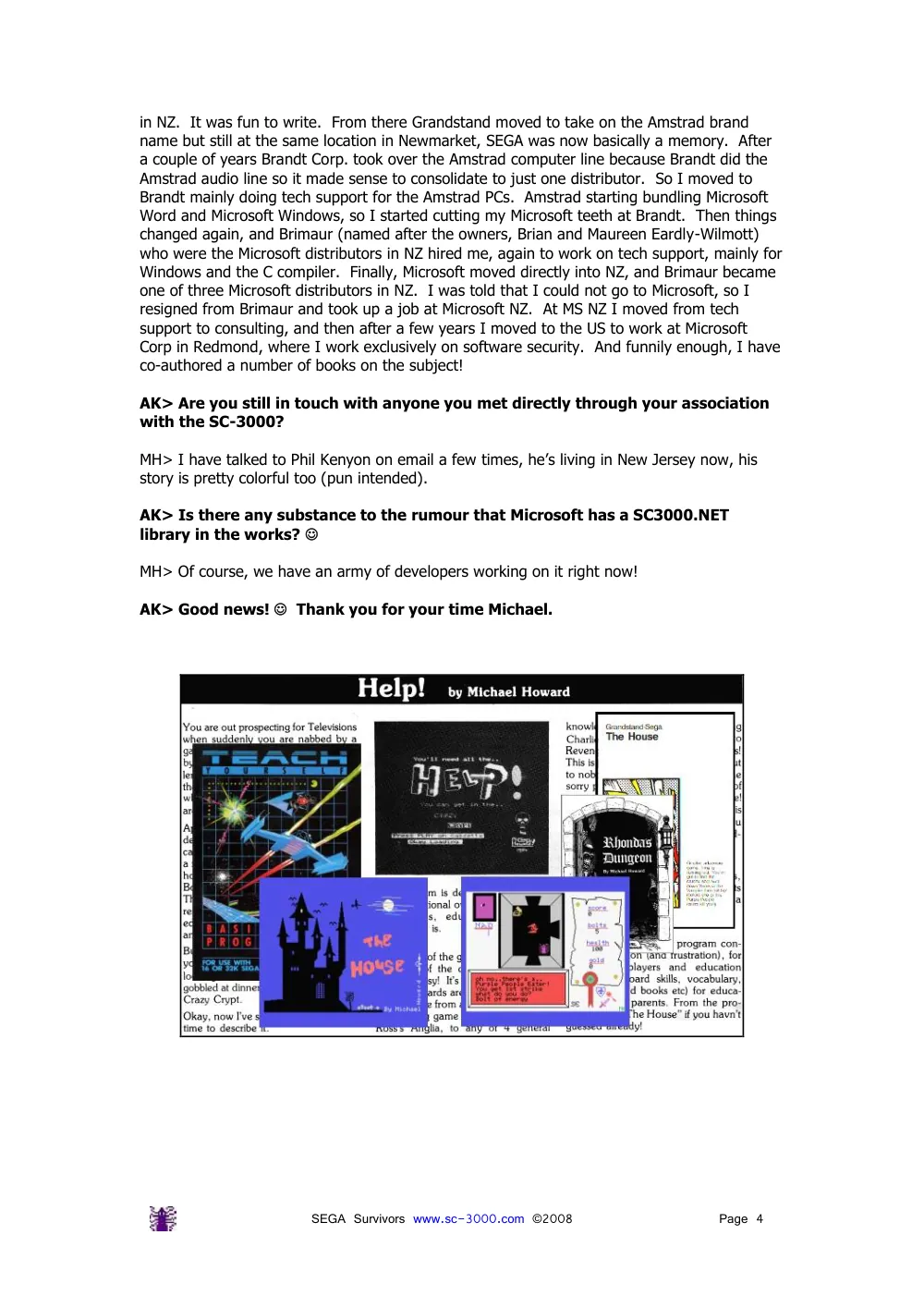
![Michael Howard — from the work: Programmer of "The House", "Help!" [aka Crazy Crypt] and many other titles for the SEGA SC-3000.](/interviews/interview-with-michael-howard/Mural.jpg "Michael Howard — from the work: Programmer of \"The House\", \"Help!\" [aka Crazy Crypt] and many other titles for the SEGA SC-3000.")